




Recent Letters
Friday 17th July 2026
Dear Parents and Carers
We’ve reached the end of another hugely rewarding year and I want to say a massive thank you to you all, as well as share some information for September, along with a couple of staff updates and some of our statutory outcomes.
Your support has been invaluable, as ever, and your children have done brilliantly well. Once again, they have made amazing progress, and you should be hugely proud of their efforts this year – we certainly are. The way they consistently demonstrate our school values – collaboration, aspiration, respect and endeavour – is wonderful to see.
The children return to school on Monday 7th September 2026. School staff will be in on Thursday 3rd and Friday 4th for INSET days, and we’ll be in touch with you again then, to remind and update you. The start and end times of the school day – see the table below – will remain the same as this year.
| Year | Gate open | Doors open | Registration | Gate closed | Pick-up | Entrance | Door |
| 6 | 08:35 | 08:40 | 08:45 | 08:50 | 15:25 | Main gate | Phase 3 North |
| 5 | 08:35 | 08:40 | 08:45 | 08:50 | 15:25 | Main gate | Phase 3 South |
| 4 | 08:35 | 08:40 | 08:45 | 08:50 | 15:20 | Main gate | By school library |
| 3 | 08:35 | 08:40 | 08:45 | 08:50 | 15:20 | Main gate | Phase 2 North |
| 2 | 08:35 | 08:40 | 08:45 | 08:50 | 15:20 | Main gate | Phase 2 South |
| 1 | 08:35 | 08:40 | 08:45 | 08:50 | 15:15 | Main gate | Classroom |
| R | 08:35 | 08:40 | 08:45 | 08:50 | 15:15 | Main gate | Classroom |
I have a couple of additional staff updates to share with you all. We have appointed two new Learning Support Specialists – Eseosa Ogbeide and Helen Borlase. They start in September and we’re looking forward to welcoming them to the team.
Naturally, I can’t not mention our very recent Ofsted visit. Whilst not ideal to receive The Call on the final Monday of the school year, with temperatures as they are, we’re very pleased to not have to wait until next academic year. And although I can’t share the official judgements with you until the autumn term, once we’ve received the report, I can say that we’re really pleased with the outcomes. The inspectors were full of praise for our inclusive practice, the curriculum and teaching including oracy, the achievement of our pupils, as well as their attitudes to learning and their excellent behaviour, our Early Years provision, the personal development offer here, and the leadership of the school. The clear message they received from you really backed up what they were seeing in and around the school, so thank you very much to the 150 of you who answered the survey and took the time to leave so many wonderful comments. However, the biggest impact of all on the inspectors, was made, unsurprisingly, by your children. To say they were extraordinary would be a massive understatement! The team of inspectors spent hours (collectively) talking to them – during lessons, in sessions with their books, in ‘formal’ meetings with groups of boys and girls and of pupil leaders, and informally at playtimes – and they literally couldn’t speak highly enough of them. We’re incredibly proud of them, as I know you are too.
Below you’ll find some of our statutory outcomes for this academic year. The ones that are missing are the KS2 SATS outcomes, which only got published yesterday so we’ve not had the opportunity to analyse these yet. We’ll share them with you all in September, but the Year 6 parents and carers will receive their children’s KS2 SATS report cards today, as required. Although, your children’s education is about much more than statistics, the headline attainment outcomes for the statutory national assessments do show how well they’re doing here at Filton Avenue Primary School. We all have a lot to be very proud of, though naturally we won’t be resting on our laurels, and the standards the school is achieving is testament to the work of the team here at Filton Avenue, the efforts of the children and of your support for the school.



A translatable version is available here.
Finally, I’d just like to take the time to wish you all a lovely summer and look forward to seeing you all again in September.
Yours sincerely,
Dan Rodeck
Headteacher
Tuesday 30th June 2026
Dear Parents/Carers,
Re: Annual Records of Achievement
On Friday, you will be receiving your child’s Annual Record of Achievement. In the report, you will read about the knowledge and skills your child has developed over the year, the subjects they have enjoyed the most, the values they have displayed and their main achievements and successes. There may also be some advice as to how you can help them at home.
The report contains the following Assessment Information:
Assessment is on-going, lesson-by-lesson, week-by-week, and is collected formally three times a year. At the end of Terms 1 and 3 pupils are assessed as being ‘On-track for GDS’, ‘On-track for EXS’ or ‘Not on-track for EXS’, based on teacher’s assessment of the key performance indicators (KPIs), which you will have discussed with your child’s teacher at parent/carer consultations. In February, you also received a mid-year report that gave you this information. At the end of Term 6, pupils are assessed directly against the KPIs; these are the objectives taken from our curriculum that have been agreed to be the most important (in each year group) in determining attainment and progress across Years 1 – 6. The teachers’ assessments are corroborated by standardised tests that the children sit at different points throughout the year. The guidelines below provide information explaining what the judgements in this Annual Record of Achievement mean.
GDS – children working at Greater Depth, within the Expected Standard, are secure in all the age-related, end of year key performance indicators, and will be deepening and broadening their knowledge and understanding of these expectations.
EXS – children working at the Expected Standard are secure in all the age-related, end of year key performance indicators.
Just below EXS – children working just below the Expected Standard are not secure in the age-related, end of year key performance indicators.
Well below EXS – children working well below the Expected Standard are not secure in the age-related, end of year key performance indicators from their year group and also have gaps in their knowledge of curriculum objectives from previous year groups.
For children in Reception, the reports are largely the same, with content that is primarily based around what your child has achieved this year. The main difference is the language of attainment, which relates to the Early Learning Goals. Additionally, there is also box for your child’s comments.
Emerging – children are working below the expected standard and have not achieved the Early Learning Goal.
Expected – children are working at the expected standard and have achieved the Early Learning Goal.
If your child is in a statutory assessment year group, i.e. Reception, Year 1, Year 4 or Year 6, you will also receive a copy of their outcomes in the assessment taken, except for Year 6 who will receive theirs on Monday 13th July.
Translatable version of this letter is available here.
If you would like to discuss your report further, please contact your child’s class teacher for an appointment.
Yours sincerely,

Dan Rodeck
Headteacher
Monday 29th June 2026
Dear Parents and Carers
Re: staffing news
I am writing to let you know of a few staffing changes that will be happening at the end of this term and at the start of next academic year. These include some departures (not all permanent), as well as returning and new colleagues.
Starting with some colleagues who are leaving, but only temporarily. Miss Noelle Dallas and Mrs Megan van Doorslaer both start their maternity leaves at the end of this term. Naturally, we wish them and their partners all the very best and look forward to hearing their news in due course. Another temporary departure is Miss Hiba Yuusuf, who is taking a sabbatical and is going to be teaching abroad next year. We wish her all the very best for an exciting chapter in her teaching career.
Sadly, we have a number of colleagues leaving us permanently this summer, all of whom will be missed greatly, both professionally and personally.
Miss Sarah Stefanini joined the school in 2016, and after a hugely influential decade here she has decided to explore different career paths. Mrs Pauline Ralph, who has been at our school since 2017, is also taking some time away from school as she decides what she wants to do next. Mr Peter Scammell, who started here in 2022, is leaving us to train to become a teacher, which we’ve no doubt he’ll be brilliant at! Ms Cat Stockham, who joined in 2023, is sadly leaving due to personal circumstances.
I’m sure you’ll join me in thanking them for everything they’ve done for the school during their time here at Filton Avenue Primary and wishing them all the very best for the future.
Moving onto the subject of colleagues either returning or joining us in September, we are very pleased that Miss Abbey Cook will be back teaching at Filton Avenue after her maternity leave. We are also delighted that Mrs Anna Mooney is returning to her administrative role after taking a sabbatical. We have one new colleague starting with us in September, Mr Scott Holbein, a class teacher. Naturally, we’re very much looking forward to welcoming him to the team. Plus, we are recruiting for a new Learning Support Specialist, and I’ll keep you informed of developments there.
As always at this time of year, I know that you and your child(ren) are very keen to know who their teacher for next year will be. After a very thorough and comprehensive process, we have let our colleagues know this information last week, and we’ll inform you on Wednesday, via Arbor. Following this, we will communicate with you re plans for transition.
There are only a few weeks between now and the end of term, but it’s important that you’re kept well informed of changes and that you hear things officially, not on the grapevine.
Translatable version is available here –
If you’d like to discuss any of the above, please don’t hesitate to come and talk to me.
Yours sincerely,

Dan Rodeck
Headteacher
Friday 12th June 2026
Dear Parents and Carers
Re: Term 6 information
Term 6 is always a very busy term full of end of year activities, but it’s also a time when a lot of planning for the next academic year happens. With this in mind, I’m writing to share news of some key dates that you’ll be interested in.
- We are currently finalising the staffing plan and will confirm this, including which class will have which teacher, via Arbor around the end of this month.
- ‘Meet your Teacher’ happens on Wednesday 15th July. The children will spend time with their teacher, in their new classroom, doing activities that will support their transition and build a sense of belonging before September.
- There’s a range of transition activities planned for children across the school, whether they’re moving years or phases, or joining us in September or leaving us in July. We will let you know more about these as the term progresses.
- Some children need more of an enhanced transition and Miss Read and/or your Phase Lead will be in touch with you personally to discuss this.
- In the background, teachers will be having transition meetings with your child’s current class teacher(s) and LSSs will be involved in discussions around provision for next year.
- Teachers are currently writing Annual Records of Achievement, and these will sent home on Friday 3rd July.
Other dates, such Year 6 events and Sports Day have already been shared on the Diary Dates, but we’ve included in this email.
Translatable version is available here –
If you’d like to discuss any of the above, please don’t hesitate to come and talk to me.
Yours sincerely,

Dan Rodeck
Headteacher
Tuesday 9th June 2026
Dear Parents/Carers of Year 4 Children
Re: Year 5 classes for 2026-27
Looking ahead to the next academic year, which is fast approaching, we want to inform you that we will be mixing up the current Year 4s into new class groups. Although we don’t have a specific policy for this, many of you will be aware, it is something we have done successfully in previous years.
We know that mixing classes can cause some anxiety and are aware that good friendships have developed over the years, which we would not want to negatively affect. We understand that class placements are important to children and families, and so we approach this process with great care.
In creating classes, teachers and leaders will be working together using their detailed knowledge of each child’s academic, social and emotional needs to create balanced classes where all children can thrive. As part of this process, over the next week, we will be asking all children across Year 4 to name three peers that they work or play well with. While we cannot keep all friendship groups together, we will endeavour to ensure that all children are placed with familiar peers and are supported in building positive relationships across the year group.
Translatable version is available here.
If would like to talk about this matter, then please don’t hesitate to get in touch with me or another member of the Leadership Team.
Yours sincerely,
Dan Rodeck
Head Teacher
Thursday 26th February 2026
Dear Parents/Carers,
Re: Anti-bullying Policy and Our Shared Definition of Bullying
At Filton Avenue Primary School, we are committed to creating a safe, happy and inclusive environment where every child feels valued and able to learn. We are writing to re-share our school definition of bullying and to remind families about our Anti-Bullying Policy, which outlines how we work together to prevent and respond to bullying.
Our Definition of Bullying
At Filton Avenue, bullying is defined as:
- The repetitive, intentional hurting of one person or group by another where there is an imbalance of power. Bullying can be physical, verbal, emotional or online.
- This definition helps us distinguish bullying from one-off incidents, disagreements or friendship difficulties, which are a normal part of children learning to manage relationships and are addressed in different ways.
Our Approach to Bullying
We work proactively to prevent bullying through:
- PSHE lessons and assemblies that promote respect, empathy and kindness
- Clear expectations for behaviour across the school
- Encouraging children to speak out and seek help
- Teaching children how to be supportive upstanders
In the very rare cases that bullying occurs, it is taken very seriously and is treated as a safeguarding concern. When concerns are raised, we will:
- Listen carefully to all children involved
- Investigate incidents thoroughly
- Support the children who have been affected
- Work with the child who has displayed bullying behaviour to help them understand the impact of their actions and make positive changes
- Communicate with parents and carers and agree next steps
- Continue to monitor the situation to ensure it is resolved
Our approach focuses on education, support and restorative practice, alongside clear expectations and consequences where appropriate.
Our full Anti-Bullying Policy is available on the school website, and we encourage all parents and carers to read it.
Working Together
We value the partnership between school and home. If you have any concerns about your child or another pupil, please speak to your child’s class teacher or a member of the leadership team as soon as possible. Early communication helps us resolve issues quickly and effectively.
A translatable version of the letter is available here – https://filtonavenue.com/we-parents/parent-guide/recent-letters/
Thank you for your continued support in helping us ensure Filton Avenue remains a caring and respectful community for all.
Yours sincerely,
Sarah Stefanini
Deputy Headteacher
Monday 23rd February 2026
Dear parents/carers
Re: Ramadan
Filton Avenue Primary School embraces the diverse cultural, ethnic and religious backgrounds represented in the school community – it’s one of the things that makes this school so special.
As many of you are aware, last week saw the start of Ramadan. For those of you who didn’t know, Ramadan is observed across the Muslim world and is a 29 to 30-day period of prayer, fasting, self-control, charity-giving and goodwill to others. Ramadan is a time of self-reflection, increased religious devotion and self-control over the need to eat and drink during daylight hours.
Fasting during Ramadan is one of the Five Pillars of Islam, and although children of primary age are not required to fast, we recognise that some of our children may want to, even if partially. We are also conscious that they may wish to pray during the school day.
With both in mind, we wanted to let you know that we are able to offer a supervised, quiet space, where children who wish to pray, and/or who are fasting, can spend their lunchtimes with Miss Yuusuf, in the 1Y classroom.
If your child does wish to fast and/or pray, please could you let us know. Having this information from parents/carers will help us support the children, as best as possible, during this period.
A translatable version of this letter is available here.
We’d like to take this opportunity to wish you Ramadan Mubarak!
Yours sincerely,

Dan Rodeck
Head Teacher
Monday 9th February 2026
Dear Parents/Carers,
Re: Mid-year Attainment and Progress Reports
Since last year, we have started publishing mid-year attainment and progress reports for each of the children in Year 1–6 in October and February, and Reception in February; these will be sent home with your child(ren) this week. Whenever School Surveys are circulated, a number of you said that you didn’t feel well enough informed of your child(ren)’s attainment and progress throughout the year, and we believe the information contained in these reports will support you with this. They are designed, using our assessment tracking software, Insight, to provide you with simple, at-a-glance attainment information, which will also give you an idea of the progress your child has made from the end of the last academic year.
In order for you to fully understand these reports, there is a table on the following page that explains what the different terminology and abbreviations mean, as well as making it clear when exactly the assessments were made/taken. Some of the language you’ll recognise from the Annual Records of Achievement you receive in July, and you will have heard teachers use it during your consultation meetings with them. We have added two new assessments to the reports: Year 1 – Reading – Phonics Score and Year 4 – Mathematics – Multiplication Tables Check, both are statutory end of year assessments, so we believe that keeping informed of your child’s progress towards them is really important.
A couple of key points for you to consider when you’re looking at the reports. Progress isn’t always consistent, and you may see that your child has a different outcome than they did previously. This could be for various reasons, for example, the change in curriculum demands as you move from one year group to another. Also, the assessment outcomes are just a snapshot and obviously don’t tell the whole story of your child and their learning. Their teacher will be happy, and able, to talk these and other things through with you later this week.
For some children, we need to provide assessment information based on their stage of learning rather than their age. These families will be contacted directly.
As well as the mid-year reports, we will also send home the Annual Record of Achievements at the end of the year, which provides you with a more complete picture of your child and their learning throughout the year.
A translatable version of the letter is available here – https://filtonavenue.com/we-parents/parent-guide/recent-letters/
I am also happy to answer any questions you have but naturally won’t know detailed information about the assessment outcomes of each child.
Yours sincerely,

Dan Rodeck
Headteacher
Assessments
| Subject | Last year | Autumn | Spring | Summer |
| Reading – Teacher Assessment Writing – Teacher Assessment Mathematics – Teacher Assessment These are made by teachers using their professional judgement, based on our Trust’s key performance indicators (KPIs). | Working Towards (WTS) – Working Towards the Expected Standard: pupils are not secure in the age-related, end of year key performance indicators. Working At (WA) – Working At the Expected Standard: pupils are secure in all the age-related, end of year key performance indicators. Greater Depth (GDS) – Working at Greater Depth, within the Expected Standard: pupils are secure in all the age-related, end of year key performance indicators, and will be deepening and broadening their knowledge and understanding of these expectations. For Year 1 pupils you will see the word ‘Emerging’ or ‘Expected’ – these are the assessments they receive at the end of their Reception year, relating to the Early Learning Goals. | These assessments are made at the end of Term 1. Not on-track for EXS: currently, pupils are not going to meet the end-of-year age-related expectations. On-track for EXS: currently, pupils are going to meet the end-of-year age-related expectations. On-track for GDS: currently, pupils are going to exceed the end-of-year age-related expectations. | These assessments are made at the end of Term 3. Not on-track for EXS On-track for EXS On-track for GDS | These assessments are made in Term 6. Well Below EXS Just Below EXS EXS GDS These new assessment bands will be used for the first time at the end of this academic year, replacing the three assessment bands explained in column 2 of this table. We believe they will provide a bit more nuance to the end of year assessments and will explain them in more detail when we send out the Annual Records of Achievement in July. |
| Reading – Test Performance Indicator (TPI) Mathematics – Test Performance Indicator From the tests, children are given a TPI, which is a projection of end-of-year outcomes. | These TPIs are new this academic year and are used for Year 2 – 6 children at all assessment points and for Year 1 children in Term 6. | These tests are taken at the end of Term 2. WTS – Working Towards the Expected Standard EXS – Working At the Expected Standard GDS (or HS for Year 6) – Working At Greater Depth, within the Expected Standard | These tests are taken at the end of Term 4. WTS EXS GDS | These tests are taken at the end of Term 6. WTS EXS GDS |
| Reading – Phonics Score These are mock-tests taken in Term 2 and 4 of Year 1, in preparation for the statutory Phonics Screening Check (PSC) in Term 6 – the pass mark is 32 out of 40. | N/A | These tests are taken at the end of Term 2. 0 – 40 (32+ equals a pass) | These tests are taken at the end of Term 4. 0 – 40 (32+ equals a pass) | The statutory PSC tests are taken at the start of Term 6. 0 – 40 (32+ equals a pass) |
| Mathematics – Multiplication Tables Check These are mock-tests taken in Term 1, 3 + 5 of Year 4, in preparation for the statutory Multiplication Tables Check (MTC) in Term 6 – the pass mark is 25 out of 25. | N/A | These tests are taken in Term 1. 0 – 25 (25 equals a pass) | These tests are taken in Term 3. 0 – 25 (25 equals a pass) | The statutory MTC tests are taken at the start of Term 6. 0 – 25 (25 equals a pass) |
Friday 16th January 2026
Dear Parents/Carers
Re: Our 2025 Achievements
Welcome back to Term 3! It’s been a great first week and the children have settled back into their routines brilliantly.
As we start 2026, I wanted to take this opportunity to look back on the year just finished and reflect on the huge range of successes and achievements that the school and, in particular, the children who attend Filton Avenue Primary have accomplished. To be fair, I could fill many more than these pages but I’m choosing to focus on 6 key areas, which paint a clear picture of what the school is all about.
Before I get into the details, I think it’s really important to let you know that we welcome a lot of visitors to our school every year. Wherever they’re from, they are either purposefully coming to see the fantastic practice here or they’re visiting for another reason and notice it. These two quotes from recent visitors sum it up nicely.
“Thanks so much for showing us around your beautiful school this morning. It’s vibrant and calm and your pupils are an absolute credit.”
“We loved walking the school and meeting your pupils; we were hugely impressed by the attitudes to learning that we saw across the school and look forward to our next visit.”
The information below provides an insight into why they come and visit. I’m sure you’ll recognise some of this from your own personal experiences of Filton Avenue Primary School.
Academic Outcomes
In July, I wrote to you all and shared the statutory academic outcomes of the children at our amazing school. As you know, two of our core values are Aspiration and Endeavour, and what your children achieved exemplifies these perfectly. From Reception (Early Learning Goals and a Good Level of Development), through Year 1 (Phonics Screening Check) and Year 4 (Multiplication Tables Check), to Year 6 SATS, our results consistently match or exceed both local and national benchmarks. As a headline, 62% of our Year 4 children last year achieved full marks (25/25) in the MTC. This compares to 37% nationally and puts us in the top 10% in the country. At the end of Year 6 last year, 65% of our children reached the Expected Standard in all three subject areas combined (reading, writing and maths), and for the same combined subjects, our Higher Standard outcomes were 17% which also places us in the top 10% in England. On the last day of term, I received notice that we’d been listed in the Bristol World’s Top 25 schools in the West of England which have exceeded expectations – https://www.bristolworld.com/education/25-west-of-england-primary-schools-which-exceeded-expectations-5449338?page=5 – naturally, we’re very proud of this, as it clearly outlines the culmination of the children’s hard work throughout their journey through the school and reflects extremely well on our curriculum and the quality of teaching. All our statutory outcomes are available to view here –https://filtonavenue.com/wp-content/uploads/2025/12/Insight-Statutory-Assessments_2024-25-validated.pdf
Personal Development
Personal Development refers to the planned activities we design to help your children grow as individuals beyond academic learning, focusing on building skills, attitudes, and values that support their character, well-being and future success. 2025 felt the year that our Personal Development offer went to another level. From off-site visits to the visitors we invite to school, to our Enrichment Days and our long-term partnerships with Bristol Beacon and Bristol Sports, which provide our children with opportunities to perform and compete in citywide events, like the Big Summer/Winter Sing, we are always looking at how we can enrich our children’s educational experiences. Taking nearly 400 children to Bristol Hippodrome last month was clearly a highlight and the introduction of our Family Dining for Year 3 – 6 has added a whole new dimension to lunchtimes. We have just under 50% of the school’s children engaged in before-school, lunchtime or after-school extra-curricular clubs and activities, and we have 200 children from Year 1 – 6 actively involved in one (or more) of the now 9 different pupil leadership roles available to them (Belonging Champions, Digital Leaders, Eco Team, Librarians, Mental Health Champions, O-Pals, Oracy Champions, Pupil Advocates and School Council).
In 2026 we have exciting plans to introduce the CARE Awards, which will give every child in the school the opportunity to challenge themselves and to celebrate belonging at Filton Avenue, and in the next few months we are aiming to be re-accredited by OPAL and become a triple platinum school! We will also look at how Family Dining can become a part of our KS1 provision.
‘The Filton Avenue Way’, anchored in our core values of Collaboration, Aspiration, Respect, and Endeavour, guides behaviour and relationships across the entire school community. We love how our children embody this each and every day and I know it inspires me and my colleagues to be the best that we can.
Oracy
Our oracy provision continued to go from strength to strength in 2025, and we were delighted to have our status as a Voice 21 Centre of Excellence reconfirmed last year. Oracy is key part of our curriculum offer, and each and every day your children expertly display their speaking and listening skills. As a Centre of Excellence, we host regular Oracy Open Mornings, where visitors from other schools in Bristol, and as far away as Wales, Birmingham and Manchester, come to see the teachers, LSSs and most importantly the children in action. Our next Oracy Open Morning is on Wednesday 11th February and I look forward to sharing some of our visitor’s wonderful comments with you very soon.
Inclusion
One of the key aspects of the school’s ethos is inclusivity, and the diversity within the school is one of things that makes it such a special place to learn and work. Filton Avenue Primary School has long been recognised for our support of children with SEND, and this year in particular we have regularly received feedback from outside agencies and professionals who work with us about the quality of our offer and the forward-thinking nature of our provision, whether that’s in-class, through interventions or our two Nests.
“It was really lovely to visit Filton Avenue school, the sense of safety and nurture for the children was thoroughly felt and the class teachers that I saw did an amazing job at delivering unconditional positive regard for all of their students. I am in and out of schools all the time and impeccable classroom management was a real treat to see as it’s becoming rarer.”
“I just wanted to say thank you for having me this morning. The pupils that we looked at all had a really comprehensive graduated response in place and there is clear and appropriate provision in the classrooms. You have lots to celebrate!”
One important, and very exciting, addition to our school is the CARE Car and I know from speaking to you and your children that seeing it driving around the neighbourhood is great fun. Perhaps, this time next year, I’ll be talking about the addition of a school dog to our community…
Community
The final area I’m going to mention is arguably the most important of all. Serving this wonderful community is the very reason the school exists, and, as I say regularly, we couldn’t do what we do without your support, each and every day. As well as going out into the community, we love bringing the community into school and, after the success of last year’s event, we will be holding our next We Belong event on March 11th 2026 – we can’t wait to celebrate our community and everyone’s heritage, including hosting an Iftar.
Special mention here needs to go to the FFA (Friends of Filton Avenue) for all the work they did in 2025. From the regular fundraising events to the big occasions like the superb Summer Fair and the fabulous Festive Fun, the team have taken things to another level. A perfect example of what you have all achieved through the FFA is The Park play equipment – without the team’s efforts and your contributions this would not have been possible, and if you ask the children they will tell you exactly how great it is!
This quote, I think, encapsulates our school community very nicely.
“My son started at Filton Avenue in September, and they are a great school. The leaders are always visible; they stand at the gate every drop off and pick up and are very approachable. Communication is great, they have an app where teachers put updates and messages and you can also message the teacher/year group leaders directly on there. They have the FFA who do a huge amount. They set up WhatsApp groups for parents of each class to join before the children start which I thought was fab.”
As always, we love to hear what you think about the school and over the next couple of terms we will be asking for your opinions through a couple of different surveys – more details coming soon. In the meantime, you can read some of your previous comments here – https://filtonavenue.com/together/parent-questionnaire-latest/
So, lots to reflect on and there’s even more to look forward to in 2026. Thank you for your support and partnership, and of course for lending us your amazing children every day. It is their kindness, sense of fun and enthusiasm for learning that makes all of the above possible.
Yours sincerely,

Dan Rodeck
Headteacher
Tuesday 21st October 2025
Dear Parents/Carers,
Re: Mid-year Attainment and Progress Reports
Since last year, we have started publishing mid-year attainment and progress reports for each of the children in Year 1–6 in October and February, and Reception in February; these will be sent home with your child(ren) this week. Whenever School Surveys are circulated, a number of you said that you didn’t feel well enough informed of your child(ren)’s attainment and progress throughout the year, and we believe the information contained in these reports will support you with this. They are designed, using our assessment tracking software, Insight, to provide you with simple, at-a-glance attainment information, which will also give you an idea of the progress your child has made from the end of the last academic year.
In order for you to fully understand these reports, there is a table on the following page that explains what the different terminology and abbreviations mean, as well as making it clear when exactly the assessments were made/taken. Some of the language you’ll recognise from the Annual Records of Achievement you receive in July, and you will have heard teachers use it during your consultation meetings with them.
A couple of key points for you to consider when you’re looking at the reports. Progress isn’t always consistent, and you may see that your child has a different outcome than they did previously. This could be for various reasons, for example, the change in curriculum demands as you move from one year group to another. Also, the assessment outcomes are just a snapshot and obviously don’t tell the whole story of your child and their learning. Their teacher will be happy, and able, to talk these and other things through with you later this week.
For some children, we need to provide assessment information based on their stage of learning rather than their age. These families will be contacted directly.
As well as the mid-year reports, we will also send home the Annual Record of Achievements at the end of the year, which provides you with a more complete picture of your child and their learning throughout the year.
A translatable version of the letter is available here – https://filtonavenue.com/we-parents/parent-guide/recent-letters/
I am also happy to answer any questions you have but naturally won’t know detailed information about the assessment outcomes of each child.
Yours sincerely,
Dan Rodeck
Headteacher
Friday 3rd October 2025
Dear Parents and Carers
Re: School Community Partnership (SCP)
I wrote to you all in June explaining we are relaunching what was our Community and Parent Advisory Group (CPAG), as the School Community Partnership. This group has been supporting our aim of enhanced community engagement, building on the great work that is already happening here at Filton Avenue Primary School. Now we have a new cohort of children and families that joined our wonderful school community last month, I am committed to getting this properly up and running.
Listening and working well with school stakeholders is a key part of the school’s work and principal among these is the parent community. The participation of parents and then the wider community is an important aspect of school leadership which provides important insights into the school. Such collaboration seeks to demonstrate transparency and better decision-making and allows school leaders to work in partnership with parents and the wider community, to deliver the best educational outcomes for every pupil.
Last year, I put a proposal to the Trust for, what I believe are, some significant improvements to the model and these were agreed. It took longer than we’d hoped, but it’s better to do things well; if it’s successful here at Filton Avenue Primary the other schools in TiLA will look to adopt the model too.
I’ve attached a document that outlines the proposal for the new School Community Partnership. Firstly, you’ll notice a change of name to the School Community Partnership; I’m sure you’ll agree that this is an improvement in itself. Secondly, and most excitingly, you’ll notice that the premise of the new model is to link our pupil leadership groups (we have 9 currently) with parents and carers, as well as members of the wider community. It is this direct link between the pupils and you that has the potential to be particularly powerful and it’s this element of the proposal that has struck a chord with my colleagues in TiLA. Whilst the School Community Partnership group will have an overarching view, the three sub-groups (Culture, Health and Wellbeing, and Sustainability) will look at specific aspects of school-life, as detailed in the attached document.
A number of parents/carers have attended meetings over the last couple of years, and will be welcomed back, if they still wish to be a part of the School Community Partnership or one of the sub-groups. However, if you’ve not been involved before, but are interested in getting involved with any (or all!) of the groups, then please complete this Microsoft Form – https://forms.office.com/e/g42inra9jP – we will send further flyers next week to remind you to sign up.
For a translatable version of this letter please click on this link – https://filtonavenue.com/we-parents/parent-guide/recent-letters/
If you wish to discuss any of the above, please don’t hesitate to contact me.
Yours sincerely,
Dan Rodeck
Headteacher
Friday 19th September 2025
Dear Parents/Carers
RE: Smart Phone Survey
Toward the end of Term 6 we asked you to complete a survey so we could better understand how you about phone usage among children in our school community, and what more the school could do to support parents/carers with this. I’m delighted to be able to share some of the outcomes with you in this letter. As you’ll see, I’ve included screenshots of the graphs representing the closed questions asked, and then I’ve summarised your responses to the question, ‘What more do you think the school should do to support parents with children’s smart phone usage?’ Thank you to those of you who took the time to answer the questions, and I hope that you all find the outcomes interesting and helpful.
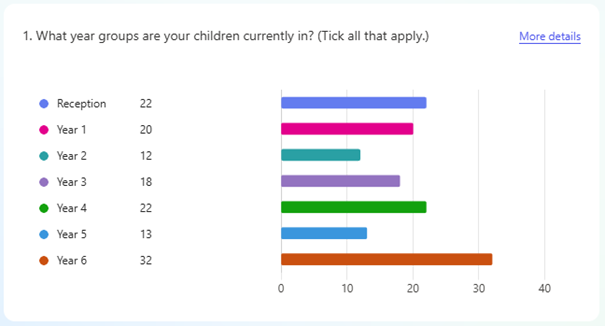
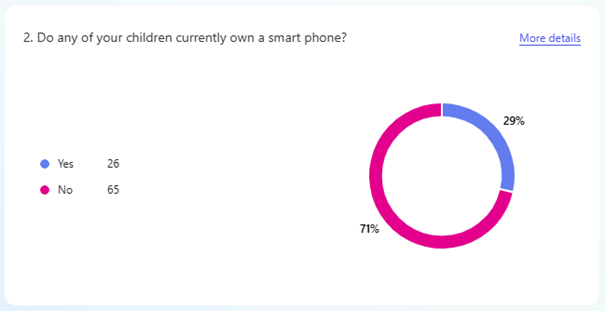
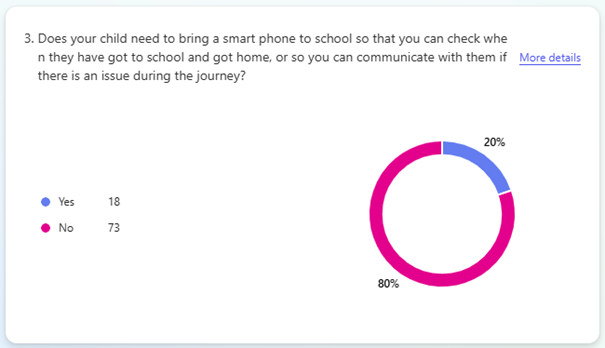
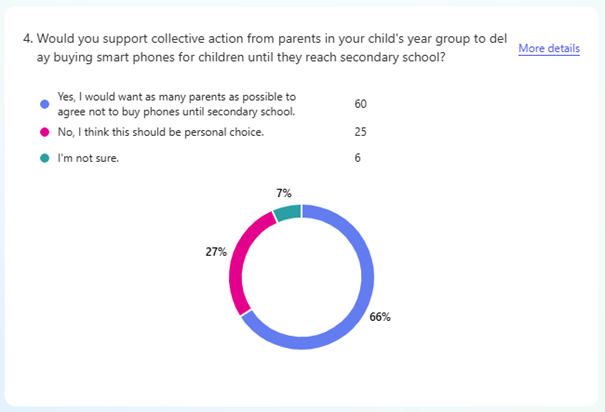
I have grouped your comments into 5 areas for ease of reading. Some of your comments and suggestions are already in place. For instance, through our Computing curriculum we teach the children about online safety throughout the year at age-appropriate levels, and we already have strict rules about children not having their phones with them in school. Over the coming year, we will look at the rest of them and work out what it’s feasible for us to achieve. We will keep you updated with any developments.
? Education and Awareness
- Workshops for parents/carers and children: covering topics like online safety, screen time vs. physical activity, mental health, app risks, and digital wellbeing.
- Early education: begin discussions in KS1 to influence habits before smartphone use becomes common.
- Focus on Apps & social media: shift the conversation from phones to the dangers of specific apps (e.g. WhatsApp, TikTok) and educate on safe vs unsafe apps.
- Parental education: encourage parents/carers to model healthy phone habits and reduce their own screen time around children; promote the risks of early smartphone use, including addiction, social media pressure, and sleep disruption.
? Digital Literacy and Self-Management
- Teach self-control and habits: help children develop discipline and awareness of screen time impacts.
- Phased introduction: promote gradual access to smartphones (e.g. Wi-Fi-only devices without SIM cards) with increasing responsibility.
- Promote reading and offline activities: encourage reading and home tasks to reduce screen reliance.
?️ Practical Support for Families
- Guides and tools: share resources on app filtering, screen time tracking, privacy settings, and safe usage.
- Alternative devices: inform parents/carers about non-smartphone alternatives and how to configure devices safely; recommend minimalist phones (e.g. Light Phone II, Punkt MP02) for communication without internet access.
- Support for lower-income families: provide tablets/laptops for schoolwork to reduce reliance on smartphones.
? School Policy and Environment
- Strict in-school rules: require phones to be switched off or locked away during the day; enforce no smartphone use during school hours, with secure storage options like Yondr pouches.
- Delayed access: encourage families to wait until secondary school before introducing smartphones.
- Monitor and communicate: contact parents/carers if children are using age-inappropriate apps.
? Parent/Carer Engagement and Support
- Safe spaces for discussion: create forums for parents/carers to share concerns and learn from each other.
- Normalize non-smartphone childhoods: promote the idea that children don’t need smartphones early, reducing peer pressure.
- Provide reassurance: offer ways for parents/carers to confirm their child’s safe arrival at school (e.g. online register).
- Mixed views acknowledged: recognize the tension some families feel between safety and screen concerns and offer balanced support.
There is a translatable version of the letter available here.
If you want to talk about any of the above, please don’t hesitate to get in touch.
Yours sincerely,

Mr Dan Rodeck
Headteacher
Monday 30th June 2025
Dear Parents/Carers,
Re: Annual Records of Achievement
On Friday, you will be receiving your child’s Annual Record of Achievement. In the report, you will read about the knowledge and skills your child has developed over the year, the subjects they have enjoyed the most, the values they have displayed and their main achievements and successes. There may also be some advice as to how you can help them at home.
The report contains the following Assessment Information:
Assessment is on-going, lesson-by-lesson, week-by-week, and is collected formally three times a year. At the end of Terms 1 and 3 pupils are assessed as being ‘On-track for GDS’, ‘On-track for EXS’ or ‘Not on-track for EXS’, based on teacher’s assessment of the key performance indicators (KPIs), which you will have discussed with your child’s teacher at parent/carer consultations. In February you also received a mid-year report that gave you this information. At the end of Term 6, pupils are assessed directly against the KPIs; these are the objectives taken from our curriculum that have been agreed to be the most important (in each year group) in determining attainment and progress across Years 1 – 6. The teachers’ assessments are corroborated by standardised tests that the children sit at different points throughout the year. The guidelines below provide information explaining what the judgements in this Annual Record of Achievement mean.
GDS – childrenworking at Greater Depth, within the Expected Standard, are secure in all the age-related, end of year key performance indicators, and will be deepening and broadening their knowledge and understanding of these expectations.
EXS – children working at the Expected Standard are secure in all the age-related, end of year key performance indicators.
Just below EXS – childrenworking just below the Expected Standard are not secure in the age-related, end of year key performance indicators.
Well below EXS – childrenworking well below the Expected Standard are not secure in the age-related, end of year key performance indicators from their year group and also have gaps in their knowledge of curriculum objectives from previous year groups.
For children in Reception, the reports are largely the same, with content that is primarily based around what your child has achieved this year. The main difference is the language of attainment, which relates to the Early Learning Goals. Additionally, there is also box for your child’s comments.
Emerging – children are working below the expected standard and have not achieved the Early Learning Goal.
Expected – children are working at the expected standard and have achieved the Early Learning Goal.
If your child is in a statutory assessment year group, i.e. Reception, Year 1, Year 4 or Year 6, you will receive a copy of their outcomes in the assessment taken. Year 6 will receive theirs on Friday 11th July.
Translatable version of this letter is available here.
If you would like to discuss your report further, please contact your child’s class teacher for an appointment.
Yours sincerely,
Dan Rodeck
Headteacher
Wednesday 25th June 2025
Dear Parents and Carers
Re: staffing news
I am writing to let you know of a number of staffing changes that will be happening at the end of this term and at the start of next academic year. These include a few departures (not all permanent), as well as returning and new colleagues.
Starting with a colleague who is leaving, but only temporarily. Miss Abbey Cook starts her maternity leave at the end of this term. Naturally, we wish her and her partner all the very best and look forward to hearing her news in due course.
Sadly, we have a number of colleagues leaving us permanently this summer, all of whom will be missed greatly, both professionally and personally.
Mrs. Ali Buckley joined the school in 2001, and after 24 years of service is taking retirement due to personal circumstances. Miss Fran Mills, who has been at the school since 2008, is moving to Cornwall, where she and her partner will set up a new life for themselves. Miss Lydia Trapnell, who has been at the school since 2012, is leaving to follow a new pathway, teaching reading on a one-to-one basis. Miss Emily Plummer, who started here in September 2020, is moving to Yeovil with her fiancé and has secured a teaching role down there (sadly, the commute is just too far!). Mrs. Sadia Khan, who started here in January 2024, is leaving us to pursue her teaching career in another Bristol school.
I’m sure you’ll join me in thanking them for everything they’ve done for the school during their time here at Filton Avenue Primary and wishing them all the very best in the next chapters of their lives.
Additionally, and very excitingly, Mrs. Sarah Stefanini is taking a short sabbatical during Term 1 + 2, to spend some time abroad with her young family. In her absence, Mrs. Gemma Kirk and Mrs. Kat Preece will be our interim co-Deputy Head Teachers, and they will bring the school the experience and continuity it needs to keep progressing.
Moving onto the subject of colleagues either returning or joining us in September, we are very pleased that Miss Hine-Jeffreys will be back teaching at Filton Avenue after her maternity leave. She will actually return for the last two weeks of term, so don’t be surprised if you see her. We have one new colleague starting with us in September, Mr Nathaniel Torrible, and two who have worked/trained here before, Miss Beth Bamford-White and Miss Charlotte Walford. Naturally, we’re very much looking forward to welcoming them to the team.
As always at this time of year, I know that you and your child(ren) are very keen to know who their teacher for next year will be. After a very thorough and comprehensive process, we have let our colleagues know this information last week, and we’ll inform you early next week, via Arbor. Following this, we will communicate with you re plans for transition.
There are several weeks between now and the end of term, but it’s important that you’re kept well informed of changes and that you hear things officially, not on the grapevine.
Translatable version is available here –
If you’d like to discuss any of the above, please don’t hesitate to come and talk to me.
Yours sincerely,
Dan Rodeck
Headteacher
Monday 2nd June 2025
Dear Parents and Carers
Re: School Community Partnership (SCP)
Many of you will be aware that we currently have a Community and Parent Advisory Group (CPAG). This group has been supporting our aim of enhanced community engagement, building on the great work that is already happening here at Filton Avenue Primary School.
Listening and working well with school stakeholders is a key part of the school’s work and principal among these is the parent community. The participation of parents and then the wider community is an important aspect of school leadership which provides important insights into the school. Such collaboration seeks to demonstrate transparency and better decision-making and allows school leaders to work in partnership with parents and the wider community, to deliver the best educational outcomes for every pupil.
With the above in mind, I’m now writing to you all to tell you about some very exciting changes that are happening, but also to apologise that I’ve not communicated about the CPAG/SCP sooner. I put a proposal to the Trust for, what I believe are, some significant improvements to the model and these have now been agreed. It took longer than we’d hoped, but it’s better to do things well and we believe that it’s now ready to launch. If it’s successful here at Filton Avenue Primary the other schools in TiLA will look to adopt the model too.
I’ve attached a document that outlines the proposal for the new School Community Partnership. Firstly, you’ll notice a change of name to the School Community Partnership; I’m sure you’ll agree that this is an improvement in itself. Secondly, and most excitingly, you’ll notice that the premise of the new model is to link our pupil leadership groups (we have 9 currently) with parents and carers, as well as members of the wider community. It is this direct link between the pupils and you that has the potential to be particularly powerful and it’s this element of the proposal that has struck a chord with my colleagues in TiLA. Whilst the School Community Partnership group will have an overarching view, the three sub-groups (Culture, Health and Wellbeing, and Sustainability) will look at specific aspects of school-life, as detailed in the attached document.
A number of parents/carers have attended meetings over the last couple of years, and will be welcomed back, if they still wish to be a part of the School Community Partnership or one of the sub-groups. However, if you’ve not been involved before, but are interested in getting involved with any (or all!) of the groups, then please complete this Microsoft Form – https://forms.office.com/e/g42inra9jP
For a translatable version of this letter please click on this link –
If you wish to discuss any of the above, please don’t hesitate to contact me.
Yours sincerely,

Dan Rodeck
Headteacher
Wednesday 17th July 2024
Dear Parents/Carers,
Re: Special Educational Needs and Disabilities (SEND) Provision at Filton Avenue Primary School
I’m writing to explain to all parents/carers our new plans for SEND Provision at Filton Avenue Primary School, starting in September 2024. Over the past year, we’ve engaged with research into how we can more effectively deploy adults to provide the best possible provision for our SEND children. Currently, we use what’s traditionally termed the 1:1 model (pairing one adult with one child) and, whilst it works in some ways, we know that in others it doesn’t. One unintended negative impact is that it can hinder a child’s independence when they are working closely with just one adult. We are therefore moving to a ‘teaching team’ approach. This approach will allow each child with SEND to build independence but also have the support they require, when they need it. The child can then be successfully supported by a number of adults, in and out of the classroom, and will not be reliant on the presence of a 1:1 to be successful. It will also allow more opportunities for the class teacher to work with the children with SEND and Education and Health Care Plans (EHCPs), while the teaching assistants (TAs) can support other members of the class.
What will the ‘Teaching Team Model’ look like at Filton Avenue?
We will build a team around each child with an EHCP, who all know the child, and can offer support to them in different ways. Where possible, children with an EHCP will stay in the classroom. The team (including teachers and TAs) will work together to enable the child to fully access learning and progress. Where applicable, children with a Provision Plan, will also receive this support. Each child will be assessed to ensure their needs are met in the most effective way.
Interventions will also take place and will tend to be delivered by teaching assistants, trained in specific programmes. By using different TAs to deliver different interventions, we will increase children’s teaching teams and enable each TA to develop expertise in a specific area of SEND. Rather than having a 1:1 deliver a number of differing interventions, children’s EHCP and Provision Plan requirements will be met by TAs who have received specific training in an intervention. 1:1 adults will only be provided for our children who are in receipt of additional funding, where medically necessary.
What does the research say?
There is an increasing amount of research now being done that focuses on how to best deploy teaching assistants. The following are the studies and texts that we’ve drawn upon in shaping these plans.
- https://educationendowmentfoundation.org.uk/education-evidence/guidance-reports/teaching- assistants
- https://www.maximisingtas.co.uk/research
- https://discovery.ucl.ac.uk/id/eprint/10001336/1/Blatchford2008Deployment.pdf
- Daniel Sobel and Sara Alston (2021), ‘The Inclusive Classroom: A new approach to differentiation’, Bloomsbury Education.
We have also been led by Parson Street Primary School, one of the other schools in the Trust, as they successfully implemented this model last year. We have worked alongside the team at Parson Street, with advice from Emma Lloyd (former Director of SEND at TiLA, and now Bristol City Council’s Head of Service for SEND and Inclusion) to develop this model of TA deployment, and we’re very excited about how it will translate to Filton Avenue.
There are a few more linked pieces of information to share with you:
- The Reflection Room is moving and evolving. From September it will be in the current 3K classroom. We need the bigger space as it will offer children re-set stations, specific to EHCP need, as well as being our centralised behaviour point. Having easy access to the small garden area is another positive reason for moving.
- The Nests will continue to operate. Arguably, this was a precursor to the plans laid out above, as it already offers specific provision according to need.
- Teaching Assistants will be renamed Learning Support Specialists, as this links well with the plans outlined in this document, and the role of teaching assistants has changed so much recently it feels appropriate.
If you’d like to discuss any of the above, please don’t hesitate to contact myself or Miss Read (SENDCo). Yours sincerely,
Dan Rodeck,
Headteacher