




Geographer
Being a Geographer at Filton Avenue
A high-quality geography education should inspire in pupils a curiosity and fascination about the world and its people that will remain with them for the rest of their lives. Teaching should equip pupils with knowledge about diverse places, people, resources and natural and human environments, together with a deep understanding of the Earth’s key physical and human processes. As pupils progress, their growing knowledge about the world should help them to deepen their understanding of the interaction between physical and human processes, and of the formation and use of landscapes and environments. Geographical knowledge, understanding and skills provide the frameworks and approaches that explain how the Earth’s features at different scales are shaped, interconnected and change over time.
The aims of being a Geographer are:
- To develop contextual knowledge of the location of globally significant places – both terrestrial and marine – including their defining physical and human characteristics and how these provide a geographical context for understanding the actions of processes
- To understand the processes that give rise to key physical and human geographical features of the world, how these are interdependent and how they bring about spatial variation and change over time
- To be competent in the geographical skills needed to:
- collect, analyse and communicate with a range of data gathered through experiences of fieldwork that deepen their understanding of geographical processes
- interpret a range of sources of geographical information, including maps, diagrams, globes, aerial photographs and Geographical Information Systems (GIS)
- communicate geographical information in a variety of ways, including through maps, numerical and quantitative skills and writing at length.
Where does it come from?
Being a Geographer is integrated into our curriculum through an enquiry-led, local learning approach. This approach recognises that the cognitive maturity of learners affects what and how they learn. It encourages learners to be a Geographer and develop their disciplinary knowledge as well as their substantive knowledge of geographical concepts.
What is ‘covered’?
Essentially, a Curious-city curriculum uses the National Curriculum 2014 areas as a basic foundation of entitlement. However Curious-city is much more than that. It is localised, real-life and challenges learners to apply their learning in unique ways without the support of adults to prove what they have learnt. Local companies, charities, organisations, individuals and objects are used as foci to enhance and instill a sense of curiosity, pride and stewardship.
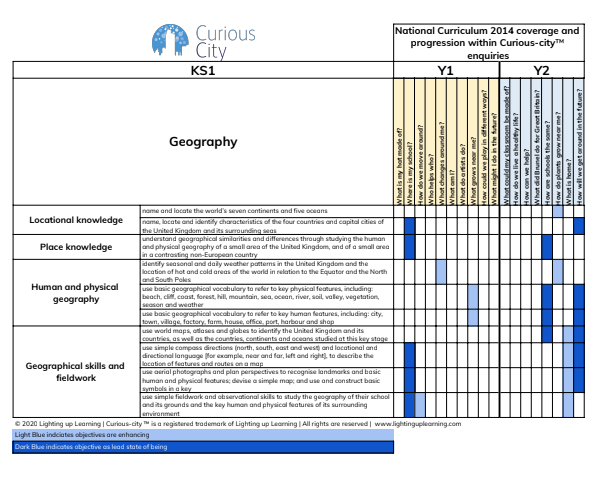
National Curriculum coverage linked to our enquiries
If you want to be a Geographer at home, try looking at these websites:
The BBC Bitesize websites link to videos, games and information a wide range of geographical knowledge:
The Geographical Association is the leading organisation supporting geographical teacher in the UK. Their resources are available at:
The Royal Geographical Society has also published a wealth of resources to help teachers and parents:
Geographer Page